A calm, practical guide for parents and caregivers navigating illness at home
There's a particular kind of morning every parent knows. You walk into your child's room and something just feels off. Maybe they're unusually quiet, maybe their cheeks are flushed, or maybe they've already called out for you in that small, tired voice that tells you everything you need to know. A sick day has arrived — and with it comes that familiar mix of worry, logistical scrambling, and the quiet determination to make your little one feel as comfortable as possible.
First, take a breath. You've got this.
Sick days are stressful, but they don't have to spiral into chaos. With a little preparation, a calm mindset, and a few simple strategies, you can keep things manageable — for your child, for your household, and for yourself. Let's walk through it together.
🌡️ Start with Calm, Not Panic
When your child isn't feeling well, your calm presence is genuinely one of the most powerful things you can offer them. Children are remarkably perceptive — they read our energy, and when they sense that we're anxious or overwhelmed, it can amplify their own distress.
That doesn't mean you have to pretend everything is fine or push down your concerns. It simply means taking a moment before you react. Breathe. Assess. Then move forward with intention.
Remind yourself: you don't have to have all the answers right away. Your job in this moment is to be present, to observe, and to reach out to the right people — your child's pediatrician or healthcare provider — when you have questions or concerns.
📋 Observe and Write Everything Down
One of the most helpful things you can do during a sick day is become a careful, consistent observer. When you eventually speak with your child's doctor or nurse, the details you've noticed will be invaluable.
Here's what's worth keeping track of:
- Temperature readings — Note the time, the reading, and which method you used (oral, ear, forehead, etc.)
- When symptoms started — Was it gradual or sudden? Did anything seem to trigger it?
- How your child is acting — Are they lethargic and hard to rouse, or tired but still interactive? Are they drinking fluids? Are they comforted when held?
- What symptoms are present — Runny nose, cough, rash, vomiting, complaints of pain? Write it all down.
- Any changes over time — Is the fever going up, staying steady, or coming down? Are new symptoms appearing?
- What they've eaten and drunk — Even rough estimates help.
You don't need a fancy system for this. A notes app on your phone, a piece of paper on the kitchen counter, or a dedicated tracking app all work equally well. The goal is simply to have a clear, timestamped record so that when you're on the phone with the nurse line or sitting in the pediatrician's office, you're not trying to reconstruct the day from memory.
A good rule of thumb: If you're unsure whether something is worth writing down, write it down anyway. More information is always better than less when you're talking to a healthcare professional.
📞 Preparing for a Pediatrician Visit or Call
Reaching out to your child's pediatrician or healthcare provider is always the right move when you're uncertain about what you're seeing. They are your partners in your child's health — don't hesitate to call their office, use their nurse line, or send a message through your patient portal.
To make that conversation as productive as possible, a little preparation goes a long way.
Before you call or go in, have ready:
- A summary of symptoms and when they started
- A log of temperature readings with times
- Notes on your child's behavior and energy level
- Any medications your child takes regularly (bring the bottles or have the names and doses on hand)
- A list of questions you want to ask — even simple ones
Questions you might consider asking your provider:
- What symptoms should I watch for that would mean I need to bring them in sooner?
- What are the warning signs that would mean I should go to urgent care or the emergency room?
- Is there anything specific I should be tracking or monitoring at home?
- When should I expect to see improvement?
Your pediatrician and their team are there to guide you through exactly these situations. You are never "bothering" them by calling with a concern about your child.
🚨 When to Seek Urgent or Emergency Care
While this post isn't a substitute for medical guidance, it's important to say clearly: always seek immediate medical attention if your child shows any signs of a medical emergency. Trust your instincts — if something feels seriously wrong, don't wait. Call your pediatrician, an after-hours nurse line, or go to urgent care or the emergency room.
Your healthcare provider can tell you specifically what warning signs to watch for based on your child's age, health history, and current symptoms.
🛋️ Creating a Comfortable Sick-Day Nest
Once you've connected with your healthcare provider (or while you're waiting to hear back), turning your attention to your child's comfort is a beautiful way to channel your caregiving energy.
You don't need to do anything elaborate. In fact, simplicity is often exactly what a sick child needs.
Setting Up a Cozy Space
Consider designating one comfortable spot — the couch, a nest of blankets on the living room floor, or their own bed — as the sick-day headquarters. Having a defined, cozy space can help your child feel settled and makes it easier for you to keep an eye on them.
A few things that tend to help:
- Extra pillows and soft blankets — Comfort is everything on a sick day.
- A small basket or tray nearby — Stock it with tissues, a water bottle or cup, a small bowl (just in case), and whatever comfort items matter to your child (a favorite stuffed animal, a well-loved book).
- Low-key entertainment — This is an excellent day for quiet movies, audiobooks, or gentle music. Screens are not the enemy on a sick day; they're a tool.
- Easy access to the bathroom — If your child is feeling nauseous or has an upset stomach, make sure the path is clear and they know they can get there quickly.
Staying Hydrated
Encouraging fluids is one of the most universally agreed-upon aspects of caring for a sick child at home — but how you offer them matters. Small, frequent sips are often easier than big glasses. Popsicles, ice chips, diluted juice, broth, or water can all be appealing depending on your child's age and what they can tolerate.
If you have questions about what fluids are appropriate for your child's specific situation or age, check with your pediatrician.
The Power of Presence
Sometimes the most comforting thing you can do is simply be there. Sit nearby. Read aloud. Watch a show together. Hold their hand. Your presence communicates safety and love in a way that no medicine can replicate.
🤝 Coordinating Care When Multiple People Are Involved
Sick days often require a village — a partner, a grandparent, a neighbor, a nanny, or a daycare provider who needs to be kept in the loop. And when multiple caregivers are involved, communication is everything.
Without a shared understanding of what's happening, it's easy for things to fall through the cracks: a dose gets forgotten, a temperature reading gets lost, or two people give conflicting information to the doctor's office.
Here are a few strategies that help:
Create a Simple Handoff Routine
Whether you're passing care to a partner at the end of the workday or leaving a grandparent in charge for a few hours, a quick verbal or written handoff makes a huge difference. Cover:
- How your child has been feeling in the last few hours
- The most recent temperature reading and when it was taken
- What they've eaten and drunk
- Any medications given, and when (always follow your healthcare provider's guidance on medications)
- What to watch for and when to call the doctor
Keep a Shared Log
A running log that everyone can see — whether it's a shared note on your phone, a whiteboard in the kitchen, or a shared app — means no one has to guess. Everyone caring for your child is working from the same information.
Designate a "Point Person"
When there are multiple caregivers involved, it helps to have one person who is the primary contact for the healthcare provider. This reduces confusion and ensures that medical guidance isn't getting filtered or misinterpreted through multiple people.
🧺 Keeping the Rest of the House Functioning
A sick child naturally becomes the center of attention — and rightfully so. But the rest of the household still needs to function, and that can feel overwhelming when you're already stretched thin.
A few gentle strategies:
- Lower your standards for the day. This is not the day to deep-clean the kitchen or catch up on laundry. The house will survive.
- Prep easy meals. Soup from a can, toast, scrambled eggs, frozen meals — simple is fine. Nourishing yourself and the rest of the family doesn't require effort today.
- Keep sick-day supplies in one place. A designated "sick day bin" with tissues, extra thermometer covers, a change of clothes, and other basics means you're not hunting through cabinets when you're already tired and stressed.
- Contain the germ zone when possible. Washing hands frequently, keeping shared surfaces wiped down, and minimizing contact between the sick child and healthy siblings can help slow the spread — though of course, in a family household, illness often has a way of making the rounds regardless.
💛 Taking Care of Yourself, Too
This one is easy to skip over, but please don't.
You cannot pour from an empty cup. When you're running on no sleep, skipping meals, and running on pure adrenaline, you're not at your best — and your child needs you at your best.
A few small things that matter:
- Eat something. Even if it's just crackers and peanut butter while standing at the counter.
- Drink water. Seriously.
- Ask for help. If someone offers, say yes. If no one offers, ask. This is not weakness; it's wisdom.
- Step away for five minutes when you can. Step outside, take a few deep breaths, and reset. You're allowed.
- Acknowledge your feelings. Worry is a normal part of loving a child. You don't have to push it away — just don't let it drive the bus.
And if you're feeling unwell yourself, please take that seriously. Your health matters, too. Reach out to your own healthcare provider if you need to.
🗓️ After the Sick Day: A Few Final Notes
Once your child is on the mend, take a moment to reset before the next time (because there will be a next time — that's just childhood).
- Restock your sick-day supplies so you're not scrambling next time.
- Follow up with your pediatrician if they asked you to check back in, or if you have lingering questions.
- Update your records — knowing when your child was sick, what the symptoms were, and how long it lasted can be genuinely useful information for future conversations with your healthcare provider.
📌 A Note Before We Go: This Is Not Medical Advice
The information in this post is intended for general educational and informational purposes only. It is not medical advice, and it is not a substitute for the guidance of a qualified healthcare professional. Nothing here should be used to diagnose, treat, or make decisions about your child's health.
Every child is different, and every illness is different. Please always consult your child's pediatrician or a qualified healthcare provider with any questions or concerns about your child's health, symptoms, medications, or treatment. If you believe your child is experiencing a medical emergency, seek emergency care immediately.
📱 Stay Organized with Fever Whiz
One of the most practical things you can do on a sick day — for yourself and for everyone helping care for your child — is keep a clear, organized record of what's happening.
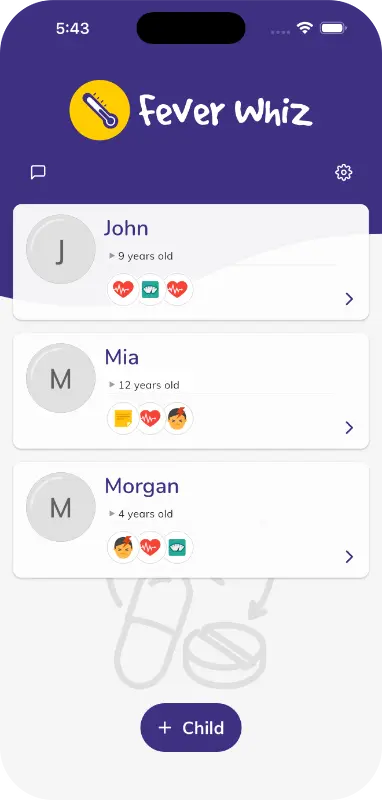
Fever Whiz is a free app designed to help parents and caregivers do exactly that. With Fever Whiz, you can:
- Log temperatures, symptoms, and medications with timestamps, so nothing gets forgotten
- Set custom and smart reminders to help you stay on top of the day
- Visualize trends through easy-to-read charts, so you can see how your child is progressing over time
- Store important medical documents in one convenient place
- Keep care notes and manage your care team
- Sync in real time across everyone caring for your child, so every caregiver is always on the same page
Fever Whiz is a private record-keeping and organization tool — not a medical device — and it does not provide medical advice or diagnosis. But when it's time to talk to your pediatrician, having a clear, detailed log at your fingertips can make that conversation so much easier.
Because on a hard day, anything that helps you feel a little more organized and a little less alone is worth having.
You're doing a great job. Sick days are hard, and the fact that you're here, looking for ways to do right by your child, says everything. Take it one hour at a time — and don't forget to take care of yourself, too. 💛