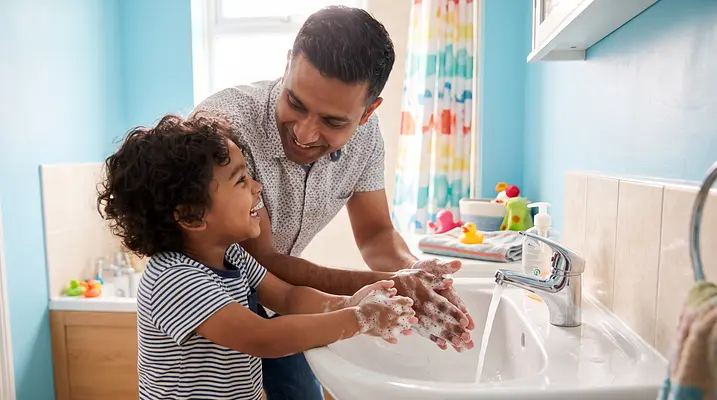
“Just two seconds?” the small voice pleads, hands hovering under the running water like a bird deciding whether to land. “But I have so many places to be, Mama. The floor is lava and my team is waiting.”
We are parked at the bathroom sink, mid-negotiation. The toilet has been flushed, the step stool is secure, and the only thing standing between my preschooler and his very important imaginary mission is a pump of foaming soap and twenty seconds of friction. It’s easy in these rushed moments—when we are late for school, or dinner is burning, or the lava is rising—to let the handwashing slide to a quick rinse. But as I look at his impatient little face, I realize this is the perfect moment to explain why we pause.
It turns out, the science of handwashing is surprisingly dramatic. It involves tearing apart microscopic invaders and physically evicting them from the premises. Once you understand the mechanics, it’s easier to be patient with the process—and easier to explain it to a four-year-old in a way that actually sticks.
🧼 The Chemistry of Clean
Most of us grew up thinking that soap kills germs on contact, the way a disinfectant spray might on a kitchen counter. The reality is far more mechanical and fascinating. Soap doesn’t just kill the bad guys; it physically dismantles them and drags them away. Understanding this chemistry helps us appreciate why a simple rinse with water just doesn't do the job.
- Picture the virus or bacterium as a tiny, sticky particle sitting on the surface of your skin.
- Imagine that many common viruses, including influenza and the common cold, wear a "raincoat" made of a fatty outer envelope.
- Recognize that soap molecules are shaped like tiny pins, with a head that loves water and a tail that loves fat.
- Understand that when you lather soap on your hands, those fat-loving tails wedge themselves into the virus’s fatty envelope.
- Visualize the soap molecules prying the virus apart, popping that protective coating like a balloon.
- Know that once the virus’s outer shell is broken, it is rendered harmless and unable to infect you.
⏱️ Why Friction Trumps Temperature
There is a persistent myth that we need scalding hot water to get our hands truly clean. We have all stood at a sink, turning the faucet handle toward the red line, thinking the heat is what sanitizes our skin. Pediatric and public health guidance is quite clear on this: the temperature of the water has very little to do with the removal of germs. It is the mechanical action—the scrubbing—that does the heavy lifting.
- Consider that hot water alone does not kill germs at temperatures safe enough for human skin.
- Remember that the water’s primary job is to create the lather and provide the rinse.
- Focus on the mechanical friction of rubbing hands together, which dislodges the dirt and microbes.
- Aim for a scrub duration of at least 20 seconds, or about the length of singing "Happy Birthday" twice.
- Pay attention to the often-missed spots: the backs of the hands, between the fingers, and under the nails.
- Realize that cooler water is often more comfortable for children, encouraging them to scrub for the full recommended duration.
🧴 The Role of Hand Sanitizer
Hand sanitizer has become a staple in diaper bags and car cup holders, and for good reason. It offers a convenient way to lower germ counts when soap and water are nowhere to be found. However, it works by a completely different mechanism than handwashing, and there are specific situations where it falls short.
- Understand that alcohol-based sanitizers work by denaturing proteins, essentially scrambling the germ's structure.
- Note that sanitizers are highly effective against many viruses and bacteria, but they do not remove physical dirt or grease.
- Remember that hand sanitizer cannot eliminate all types of germs, such as Cryptosporidium, Norovirus, and Clostridium difficile.
- Recognize that if hands are visibly dirty or greasy, the sanitizer may not reach the germs trapped under the grime.
- Treat hand sanitizer as a backup option for when you are on the go, rather than a replacement for the sink.
- Ensure the sanitizer contains at least 60% alcohol for it to be effective against the broadest range of microbes.
🦠 Explaining It to a Four-Year-Old
Explaining protein denaturation or fatty envelopes to a preschooler is a quick way to lose their attention. To get them to comply, we have to translate the science into a narrative they can visualize. We want to move away from "because I said so" and toward "because you have the power to defeat the bad guys."
- Tell your child that germs are like tiny specks of sticky glitter that are invisible to our eyes.
- Explain that soap is a "germ-fighter" that grabs onto the sticky glitter and makes it slippery.
- Describe the scrubbing motion as the "glue-breaker" that unsticks the germs from their skin.
- Show them that the water is the "river" that washes the trapped germs far away down the drain.
- Turn the 20-second rule into a game by singing a silly song about sending the germs on a waterslide.
- Encourage them to check their "tool belt" (between fingers, under nails) to make sure no germs are hiding.
🛡️ Building Habits That Last
We all want our children to stay healthy, but the daily grind of reminding them to wash their hands can be exhausting. The goal isn't just to get them to wash their hands today; it's to build a habit that protects them for a lifetime. By making the science relatable and the routine consistent, we empower them to take ownership of their own health.
- Model the behavior by washing your own hands alongside them, showing that it is a lifelong practice.
- Create a routine by tying handwashing to specific cues: arriving home, before meals, and after using the bathroom.
- Keep a step stool and foaming soap accessible so they can reach the sink independently.
- Praise the effort and the duration of the scrub rather than just the outcome of clean hands.
- Remember that consistency matters more than perfection; a happy scrub is better than a stressed-out standoff.
Quick Action Plan
- Place a sturdy step stool at every sink your child uses regularly.
- Switch to foaming soap if your child finds the lathering process more fun.
- Agree on a specific "handwashing song" that lasts at least 20 seconds.
- Model the 20-second scrub yourself every time you are at the sink together.
- Keep a travel-sized hand sanitizer in the car for those true "sink unavailable" moments.
This post is for educational purposes only and is not medical advice. Always consult your pediatrician or a qualified healthcare professional for any medical questions, symptoms, or treatment decisions.
To make tracking your child’s health easier, consider using the *Fever Whiz** app. It helps you log medications, temperatures, and symptoms, set reminders, visualize trends, store medical documents, and share a real-time care timeline with everyone caring for your child.*