Almost no parent sits in a prenatal class or reads a baby book expecting to see their child have a seizure. We are taught how to change a diaper, how to latch a baby, and how to install a car seat, but the topic of febrile seizures is rarely mentioned until it is already happening. The result is that when a child stiffens and shakes during a fever, their caregiver is often left feeling that the entire world has just collapsed around them. It is a moment of pure terror, largely because it is so completely unexpected. This post is here to explain what is happening in the body during these episodes, why they occur, and why the reality of them is often far less dire than the sight of them suggests.
🌡️ Why Temperature Changes Matter More Than Temperature Height
One of the most confusing aspects of febrile seizures for parents is the relationship between the fever and the seizure. We naturally assume that a higher fever is more dangerous, but with febrile seizures, the math is different.
Understand that a febrile seizure is triggered by a rapid spike in body temperature, not by the specific number on the thermometer. Picture a thermostat that reacts violently when it is turned up too quickly, rather than simply being set to a high number. Know that a child might have a seizure at a temperature of 102°F (38.9°C) if it rose very fast, while another child might sit comfortably at 104°F (40°C) without any seizure activity. Recognise that this is why febrile seizures often happen early in an illness, sometimes before a parent even realizes their child has a fever.
👶 The Typical Age Range and Vulnerability
Febrile seizures are not a random occurrence; they follow a fairly predictable developmental timeline. They are linked to a specific window of childhood where the brain is still maturing.
Note that febrile seizures typically occur between the ages of 6 months and 5 years. Remember that the peak incidence is usually between 12 and 18 months of age, a time when toddlers are exploring the world and picking up many viruses. Understand that this age range corresponds with a period where the brain’s electrical system is more sensitive to rapid temperature changes but has not yet developed the stability of an older child or adult. Take comfort in knowing that most children outgrow this susceptibility entirely by the time they start school.
📊 How Common They Really Are
Because they are so rarely discussed in parenting circles, seeing a febrile seizure can feel like a rare, catastrophic event. In reality, they are one of the most common neurological events in early childhood.
Look at the statistics, which show that febrile seizures occur in about 2% to 5% of all children. Compare this to other childhood conditions, and realise that in a standard preschool class, there are likely one or two children who have experienced this. Acknowledge that while the sight is frightening, the prevalence suggests that the vast majority of children recover fully and without lasting issues. Recognise that pediatricians and emergency room staff see these cases regularly, which is why they often seem calm and matter-of-fact when treating them.
⚡ Why It Looks So Terrifying
There is no gentle way to describe a seizure. For a watching parent, it mimics everything we have been culturally taught to fear about health emergencies, which is why the psychological impact is so heavy.
Watch as the child becomes unresponsive and their body stiffens or jerks rhythmically, which looks like a loss of control over vital functions. Observe that the child’s eyes may roll back, their breathing may become irregular, or their skin may change color, all of which signals "emergency" to a parent’s instinct. Expect that the episode might last a few seconds or several minutes, though even a short seizure feels like an eternity to the person watching. Understand that the visual severity is what causes the panic, often overshadowing the generally benign medical prognosis.
📉 Why the Outcome Data Is Reassuring
While the visual of a seizure suggests permanent damage or a life-threatening crisis, the medical literature on febrile seizures tells a much calmer story. The distinction between what is seen and what is actually happening is vital.
Know that the vast majority of children who have a simple febrile seizure recover completely without any brain damage or long-term health effects. Realise that a febrile seizure is distinct from epilepsy, as it is provoked solely by a fever and does not mean the child has a seizure disorder. Understand that while there is a slightly higher chance of having another febrile seizure in the future, the data does not show a link to intellectual disabilities or developmental delays. Trust that the "scary" part is the event itself, not the aftermath, which is why pediatricians focus on comforting the parent as much as treating the child.
🩺 When to Ask the Professionals
Because a seizure can be caused by things other than a fever, it is never something to diagnose on your own. This is the moment to rely entirely on the expertise of your medical team.
Contact your pediatrician or emergency services immediately if your child has a seizure, even if you suspect it is fever-related. Rely on the professionals to determine if the episode was a simple febrile seizure or if further investigation is needed to rule out other causes. Discuss any concerns you have about your child’s specific health history, as only their doctor can give you personalized guidance for future illnesses. Ask your pediatrician to explain what to look for and when to seek help, so you have a clear plan for the next time your child gets sick.
Disclaimer
This article is for educational purposes only and is not intended to provide medical advice, diagnosis, or treatment. Always seek the advice of your pediatrician or another qualified health provider with any questions you may have regarding a medical condition. If you think your child may have a medical emergency, call your doctor or emergency services immediately.
Quick Action Plan
- Download the "Fever Whiz" app to log temperatures and symptoms accurately during illness.
- Ask your pediatrician about febrile seizures at your child’s next well-visit to get personalized advice.
- Save your pediatrician’s after-hours number and your local emergency number in your phone.
- Store a list of your child’s current medications and allergies in the app for easy sharing with doctors.
- Use the app to visualize fever trends, helping you feel more in control during sickness.
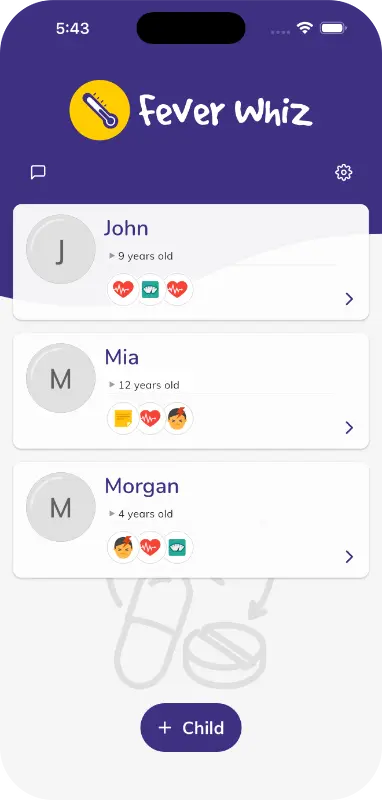
Keeping track of a sick child’s temperature and medication times can be overwhelming, especially when you are exhausted. The Fever Whiz app is a free tool designed to help parents and caregivers log every dose, temperature, and symptom. You can set custom reminders, visualize trends with charts, store important medical documents, and keep a real-time care timeline that syncs across everyone caring for your child. It is a private record-keeping and organization tool—not a medical device—to help you stay organized when it matters most.