You add them up on your fingers, or maybe on a calendar filled with scribbled notes. There was the cough in October, the week of runny nose in November, and that lingering congestion right before the holidays. By the time January arrives, you find yourself doing the unsettling math: surely we have already had six colds this winter? When you tally the sick days, the missed playdates, and the endless boxes of tissues, a nagging worry starts to form in the back of your mind. It is easy to wonder if something is fundamentally wrong with your child’s immune system, or if they are destined to be the "sickly kid" forever.
Take a deep breath. That arithmetic, while exhausting, is entirely normal. What you are witnessing is not a failure of your child’s health, but rather the rigorous, necessary training ground of early childhood. Before we dive into the science of why this happens, remember that I am a writer with a background in health literacy, not a doctor. This post is here to explain the "why" behind the sniffles, but your pediatrician is always your best resource for specific medical concerns about your child.
📈 The Normal Numbers
Before worrying that your child is an outlier, it helps to look at the standard statistics published by pediatric health organizations. Most families are surprised to learn that the frequency of illness they are experiencing falls squarely within the typical range for a young child.
- Consider that widely published pediatric guidelines state that young children commonly average six to eight respiratory infections per year. 📊
- Remember that some children in group care settings, such as daycare or preschool, may experience even more, sometimes up to ten or twelve colds annually.
- Recognize that these numbers represent a normal, expected part of development for toddlers and preschoolers.
- Know that the "sick season" often stretches from September to May, giving viruses a long window of opportunity to circulate.
🏫 The Group Care Effect
If your child attends daycare or preschool, you have likely noticed that the frequency of illnesses seems to spike. This is not a coincidence; it is a direct result of environment and exposure.
- Picture a classroom as a "library" of different viruses that children are sharing constantly. 📚
- Understand that young children are still learning hygiene habits, such as covering coughs or wiping noses, which allows germs to spread rapidly via hands and toys.
- Note that the "group care effect" is a well-documented phenomenon where early exposure to other children leads to more infections in the toddler years.
- Acknowledge that while this phase is exhausting, it is simply the "cost" of social immunity building in the early years.
🧬 Building Immune Memory
The phrase "building immunity" is often used, but what does that actually look like inside the body? It is a complex biological process that turns every infection into a lesson for the immune system.
- Imagine the immune system as a vast library with mostly empty shelves at birth. 📖
- Visualize each virus as a specific "book" that the immune system has never seen before.
- Understand that when a virus enters, the body must write a new "book"—creating specialized cells that learn to recognize and fight that specific intruder.
- Know that this process takes time, usually several days, which is why symptoms appear before the body gets the upper hand.
- Remember that once the infection is cleared, the "book" stays on the shelf, allowing the body to recognize that same virus instantly if it returns.
🦠 Why So Many Different Colds?
You might wonder why your child can’t just catch one cold and be done with it. The answer lies in the incredible diversity of the viruses themselves.
- Recognize that the "common cold" is not caused by a single virus, but by hundreds of different viruses, most notably rhinoviruses. 🦠
- Realize that immunity is often virus-specific; having immunity to one strain of rhinovirus does not protect you from the next one.
- Picture the immune system having to catalog each virus individually, like collecting hundreds of different trading cards.
- Understand that because there are so many circulating viruses, a child can catch a new one shortly after recovering from the last one.
📉 Why It Gets Better With Age
The good news for exhausted parents is that this high rate of infection does not last forever. The arithmetic of sickness changes as the years go by.
- Trust that by the time children reach elementary school age, the frequency of colds typically drops to three to five per year. 📉
- Understand that this decline happens because the "library" of immune memory is now well-stocked with the most common viruses.
- Note that school-aged children have also developed better hygiene and personal habits that reduce the spread of germs.
- Remember that the "investment" of those difficult preschool years pays off in a more robust immune system for the school years ahead.
🚨 When to Contact Your Pediatrician
While the sheer number of colds is often normal, there are times when professional guidance is necessary. Pediatric and public health sources widely list specific reasons to reach out.
- Observe if a fever lasts more than a few days or seems unusually high. 🌡️
- Notice if breathing seems labored, rapid, or if you see the skin pulling in around the ribs or neck.
- Watch for signs of dehydration, such as a dry mouth, lack of tears when crying, or significantly fewer wet diapers.
- Look for extreme lethargy or irritability that is out of character for your child.
- Contact your pediatrician or seek urgent care if you ever feel your child’s condition is worsening or if something just feels "off."
Disclaimer: This blog post is for educational purposes only and is not intended to provide medical advice, diagnosis, or treatment. The information contained here is not a substitute for professional medical advice from a qualified healthcare provider. Always seek the advice of your child’s pediatrician or other qualified health provider with any questions you may have regarding a medical condition or potential illness.
Quick Action Plan
- Reframe your mindset to view colds as immune system training rather than a failure of health.
- Keep a simple log of symptoms and dates to help you visualize the "gaps" between illnesses.
- Practice and model good hygiene, like hand washing, to help slow the spread of new viruses.
- Ensure your child gets plenty of rest and fluids during recovery to support their body's work.
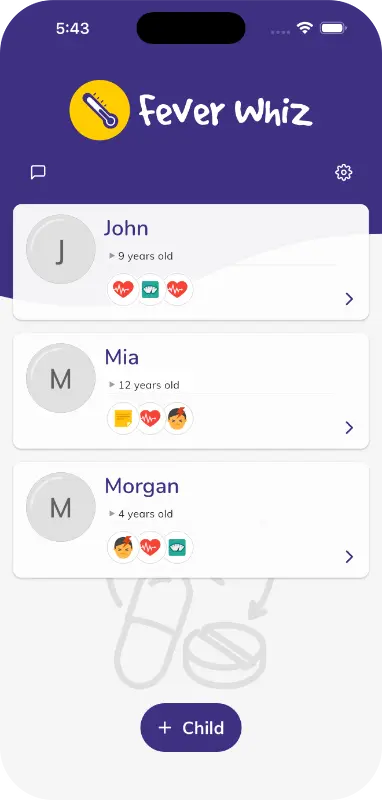
- Download the "Fever Whiz" app to easily track temperatures, log symptoms, and share a care timeline with your partner or caregivers.
Suggested Tool: Consider using the Fever Whiz app to help manage the chaos of sick days. It is a free tool for parents and caregivers that allows you to log every dose of medication, track temperature trends, and set smart reminders. You can visualize trends with charts, store important medical documents, and sync in real time with everyone caring for your child, ensuring that the "arithmetic" of sickness is at least organized. (Note: Fever Whiz is a private record-keeping tool and not a medical device; it does not provide medical advice).