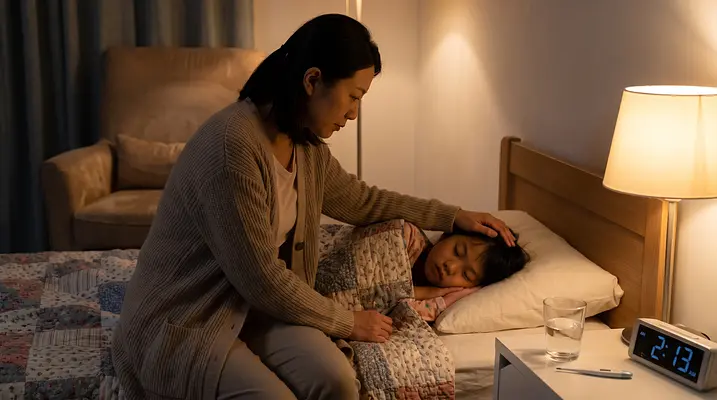
Your child seems almost back to their normal self at dinner. They are playing quietly, maybe eating a little less than usual, but certainly not seeming acutely ill. You feel a wave of relief and start to mentally plan a normal evening routine. But then the clock strikes midnight, and you are woken by a cry that sounds different—weak and fretful. When you place your hand on their forehead, it radiates heat, and the thermometer confirms a spike that wasn’t there just six hours ago.
It feels like bad luck, a cruel twist of fate that sickness waits until the sun goes down to show its true colors. Nearly every parent has noticed this pattern and quietly assumed it was just the way their particular luck ran. But this phenomenon isn’t a stroke of bad luck at all. It is actually a predictable, biological result of how the human body manages its internal thermostat, and understanding the "why" behind it can make those midnight moments feel a little less alarming.
🌡️ How the Body Sets Its Thermostat
To understand why fevers act the way they do, we first have to look at how the human body handles temperature when it is not sick. Our bodies are not meant to stay at one exact number all day long; instead, they follow a natural, gentle rhythm known as the circadian rhythm.
- Picture a gentle wave rather than a flat line, with body temperature naturally rising and falling over a 24-hour cycle.
- Know that for most humans, this internal clock runs coolest in the early morning hours (around 4 a.m. to 6 a.m.) and peaks in the late afternoon and early evening (around 4 p.m. to 8 p.m.).
- Understand that this swing of about 1 to 1.5 degrees Fahrenheit is completely normal and happens in healthy children and adults every single day.
- Recognize that "normal" body temperature is often cited as 98.6°F, but that is just an average—most people run a little cooler in the morning and a little warmer by late afternoon.
🌇 Why "Normal" Looks Warmer in the Evening
When a child is well, this daily temperature swing is hardly noticeable. They might feel slightly warmer after running around outside in the late afternoon, but it doesn't register as a fever. However, when the body is fighting an infection, this natural background rhythm gets superimposed on the illness, amplifying the effects.
- Imagine the fever "floor" being lifted up; since the body is already running hot due to illness, the natural evening peak pushes the temperature higher than it would be at noon.
- Observe that a temperature that reads 99°F in the morning might naturally climb to 101°F by evening simply because the body’s baseline has shifted with the time of day.
- Realize that the fever isn't necessarily "getting worse" at night—it is often just riding the natural wave of the body’s daily rhythm at a higher set point.
- Remember that pediatric definitions of fever generally account for this, but the visual spike on a thermometer can still look dramatic to a worried parent.
🌙 The Midnight Dip in Cortisol
There is another biological player working behind the scenes during those overnight hours: cortisol. Cortisol is a hormone often associated with stress, but it also plays a major role in regulating the immune system and keeping inflammation in check.
- Know that cortisol levels naturally fluctuate, peaking in the morning to help us wake up and dropping significantly in the late evening and overnight.
- Understand that cortisol acts somewhat like a natural brake on the immune system; when levels are high, inflammation is dampened, and when levels drop, the immune system becomes more active.
- Picture the overnight hours as a time when the immune system is "off the leash," fighting the infection more aggressively because the dampening effect of cortisol is at its lowest.
- Connect this increased immune activity to the release of chemicals (pyrogens) that tell the brain to raise the body’s temperature, contributing to that midnight spike.
🤒 Why 2 a.m. Feels So Much Worse
It isn't just the thermometer reading that makes 2 a.m. so difficult. The subjective experience of illness often feels heavier and more intense in the dark of night. There is a convergence of physical symptoms and environmental factors that make the same illness feel genuinely worse than it did at dinner time.
- Consider that fatigue lowers a child’s coping mechanisms, making them more sensitive to discomfort and less able to settle themselves back to sleep.
- Recognize that the quiet, dark house removes distractions, causing the child to focus entirely on how their body feels, which amplifies the distress.
- Remember that the natural rise in temperature can cause chills or shivering as the body tries to reach that new, higher set point, which feels physically uncomfortable.
- Acknowledge that the lack of natural daylight and the isolation of being the only one awake can make the situation feel more emotionally intense for the parent as well.
🌅 What Morning Usually Brings
Just as the evening spike is predictable, so is the morning reprieve. Parents are often surprised to find that the child who was burning up at 2 a.m. wakes up with a much lower temperature, or no fever at all. This can be confusing, leading parents to doubt what they saw the night before.
- Expect the temperature to drift back down as the morning progresses and the body’s cortisol levels naturally rise again.
- Observe that the child may seem significantly better in the morning, playing and eating, only to have the fever return by late afternoon—this "sawtooth" pattern is classic for many viral illnesses.
- Understand that this cycle can repeat for several days, which is a normal course for many common infections.
- Note that while the morning improvement is reassuring, it is the overall trend over several days that matters most to clinicians.
📋 When to Contact Your Pediatrician
While the evening spike is usually part of the natural rhythm of illness, there are times when a fever signals that a parent should reach out to a healthcare professional. Knowing the established guidelines helps parents navigate when to make that call.
- Review widely published pediatric guidance which lists specific age thresholds, such as any fever in an infant under three months old, as a reason to contact a doctor immediately.
- Note that public health sources generally advise seeking care if a fever lasts more than a certain number of days (often three to five) even if the child seems otherwise okay.
- Remember that clinicians emphasize looking at the child’s behavior—if they are extremely listless, have difficulty breathing, or show signs of dehydration, these are listed as reasons to seek care regardless of the temperature number.
- Understand that if a parent’s intuition says something is wrong, professional guidance universally supports calling the pediatrician for reassurance and direction.
Conclusion
Seeing your child’s temperature climb in the middle of the night can be a lonely, frightening experience, but it is a biological pattern as old as time. The body is simply doing what bodies do—following the rhythm of the day and the demands of the immune system. The fever isn't a punishment or a sign of failure; it is a sign that the body is working hard, even when the rest of the world is asleep.
When the sun comes up and the fever breaks, you might feel a moment of doubt, wondering if the previous night was as dramatic as it seemed. It was. The biology backs you up. You are doing a great job navigating the ups and downs of childhood illness, and knowing the "why" behind the thermometer can help you face those 2 a.m. wake-up calls with a little more confidence and a little less fear.
Quick Action Plan
- Keep a simple log of temperatures and times to show your pediatrician the full 24-hour picture.
- Use a reliable thermometer to confirm a fever rather than relying solely on touch.
- Trust your instincts—if the fever pattern worries you, contact your pediatrician for guidance.
- Remember that evening spikes are normal biology, not necessarily a sign of worsening illness.
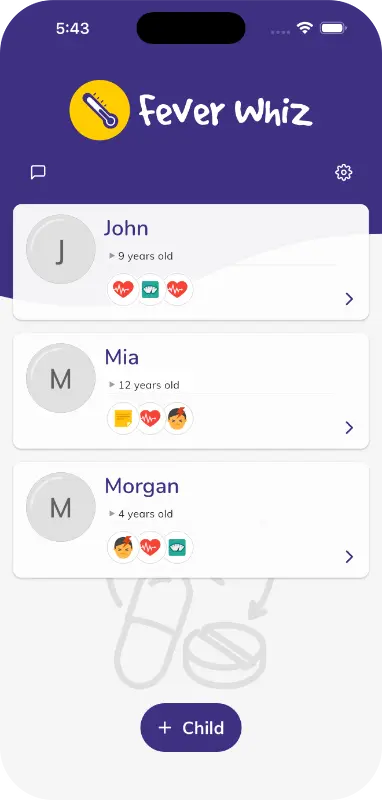
- Download the "Fever Whiz" app to easily track temperatures, log symptoms, and share a real-time care timeline with your co-parents or caregivers.
Disclaimer: This blog post is for educational purposes only and is not medical advice. The information provided is not a substitute for professional medical advice, diagnosis, or treatment. Always seek the advice of your pediatrician or other qualified health provider with any questions you may have regarding a medical condition or fever.
If you found this information helpful, consider using the *Fever Whiz** app. Fever Whiz is a free child medication, fever, and symptom tracker for parents and caregivers. Log every dose, temperature, and symptom; set custom and smart reminders; visualize trends with charts; store important medical documents; keep care notes and a care team; and sync in real time across everyone caring for your child. It is a private record-keeping and organization tool—not a medical device—and it does not provide medical advice or diagnosis.*