Let’s start with a permission you may not hear often enough: calling your pediatrician or seeking medical advice and being told it is nothing is a good outcome. It is not a wasted call, an imposition, or a sign that you overreacted. It means you have ruled out the scary things and can breathe easier. Every pediatrician and public health official would rather take a hundred calls that turn out to be nothing than miss one call where a child needed help. If you are reading this because you are worried, please take a deep breath. This article is here to help you understand the widely agreed-upon warning signs that signal it is time to stop reading and make contact with a professional immediately.
This list covers the "red flag" symptoms that essentially every pediatric and public health source lists in common as reasons to make contact without delay. These are not subtle signs; they are clear, urgent signals. However, this list is not exhaustive. Children are individuals, and they don’t always read the textbook. If your inner voice is telling you something is wrong—even if the symptoms aren't on this list—that instinct is itself a valid reason to call. You know your child better than anyone, and your sense that "this is different" is a powerful tool.
🫁 Difficulty Breathing
Breathing is something we do automatically, roughly 20 to 30 times a minute when we are healthy and relaxed. When a child is having trouble moving air in and out of their lungs, their body recruits extra muscles to help, creating visible signs of effort. Pediatric sources widely list difficulty breathing as a primary reason to seek immediate care because the body’s oxygen supply is compromised.
- Look for the muscles pulling inward above the collarbone, between the ribs, or below the ribcage (often called retractions) as the child struggles to create space for the lungs.
- Notice if the nostrils are flaring wide with each breath, a natural reflex to open the airway further.
- Listen for sounds like a high-pitched wheeze when exhaling or a harsh, grunting sound at the end of each breath.
- Observe the child’s posture or color, as some children may sit hunched forward to breathe easier, or their lips and face may appear pale or bluish.
💤 Unresponsiveness or Extreme Lethargy
It is normal to be tired when sick, but there is a distinct difference between "sleepy" and "extremely lethargic." Lethargy in a medical context refers to a state where the child is difficult to rouse, limp, or unable to interact with their environment in a normal way. This is a sign that the brain is affected, either by an infection, a high fever, or a metabolic change.
- Picture a child who cannot maintain eye contact or focus on your face, even for a moment.
- Recognize a lack of response to a parent’s voice, a favorite toy, or gentle touch.
- Understand the difference between being asleep and being unarousable; a lethargic child may be floppy like a rag doll when held.
- Consider a sudden change in behavior, such as extreme irritability that cannot be comforted, as a similar warning sign in some infants.
💧 Signs of Significant Dehydration
When a child is losing more fluid than they are taking in—through vomiting, diarrhea, or fever—the body can become dehydrated. While mild dehydration can often be managed at home under guidance, significant dehydration is dangerous. Public health guidelines emphasize contacting a professional if the body can no longer keep up with fluid needs.
- Notice a lack of wet diapers or trips to the bathroom for six to eight hours or longer.
- Look for a dry mouth or the absence of tears when the child cries.
- Observe the eyes, which may appear sunken or dark-circled in a dehydrated child.
- Remember that in infants, the soft spot (fontanelle) on top of the head may appear sunken when fluid levels are low.
🦴 A Stiff Neck Alongside Fever
A fever is the body’s way of fighting infection, but when it is paired with a stiff neck, it raises a specific red flag. This combination is widely cited as a reason to seek urgent evaluation because it can indicate irritation of the membranes surrounding the spinal cord and brain.
- Understand that a "stiff neck" in this context means the child is unable or unwilling to bend their neck forward to look down or touch their chin to their chest.
- Recognize that this is different from the muscle strain a child might get from sleeping in a funny position; it is persistent and painful.
- Note that older children might complain of a headache or sensitivity to light alongside the neck stiffness.
🔴 A Rash That Does Not Fade Under Pressure
Rashes are common in childhood, from drool rashes to viral illnesses, but one specific type of rash is treated as a medical emergency. Pediatric guidelines instruct caregivers to be concerned about a rash that remains visible even when pressure is applied to it.
- Visualize a rash that looks like tiny red or purple dots (petechiae) or larger bruise-like blotches (purpura).
- Understand that a normal rash will blanch, or turn white/pale, if you press on it and then turn red again when you release.
- Know that a rash that stays red or purple even while being pressed is a sign of bleeding under the skin and requires immediate professional attention.
⚡ A Seizure
A seizure is a sudden, uncontrolled electrical disturbance in the brain. Seeing a child have a seizure is frightening, but it is a clear signal to contact medical professionals. If your child has a known seizure disorder, you will have specific instructions from their neurologist; if this is the first occurrence, it is a reason to make contact without delay.
- Recognize that seizures can look different, ranging from full-body shaking (convulsions) to subtle staring spells where the child is unresponsive.
- Understand that during a seizure, the child is not aware of their surroundings and may not breathe normally.
- Remember that medical professionals guide the immediate steps during a seizure; this is not the time to rely on an article, but to contact emergency services.
🍼 Fever in a Very Young Infant
Fever is handled very differently in newborns and young infants than in older children. Because their immune systems are not yet fully developed, a fever in a very young infant is treated as a serious sign by pediatricians. The standard definition of a fever is a temperature of 100.4°F (38°C) or higher.
- Know that for infants under two to three months of age, any fever is widely considered a reason to contact a pediatrician immediately.
- Understand that in this age group, doctors cannot rely on the baby’s social smile or interaction to judge how sick they are, making the fever itself the warning sign.
- Recognize that rectal temperatures are considered the standard for accuracy in this age group by medical professionals.
📝 A Note on Trusting Your Instincts
It is worth repeating: this list is not exhaustive. There are countless other scenarios—from severe pain that won't go away to a sudden change in skin color—that warrant a call to the doctor. The most important tool you have is your intuition. You are the expert on your child. If you feel that something is "off," or if your child just doesn't look right to you, that feeling is valid. Pediatric and public health sources agree that a caregiver’s sense that something is wrong is itself a reason to call. Never worry about being "that parent." You are supposed to be that parent—the one who calls when they are worried.
📋 Quick Action Plan
- Post the number for your pediatrician’s office and the local emergency department somewhere visible in your home.
- Keep a simple notepad or app handy to jot down the time symptoms started and how they have changed.
- Trust your instincts—if you feel something is wrong, call, even if the symptoms don't fit a standard list.
- Remember that a call resulting in "it’s nothing" is a successful outcome, not a failure.
- Share this information with anyone else who cares for your child, such as grandparents or babysitters.
Disclaimer: This blog post is for educational purposes only and is not medical advice. It is intended to summarize widely published public health information, not to diagnose or treat any condition. Always consult your pediatrician or a qualified healthcare professional for any medical questions, symptoms, or treatment decisions, and seek urgent care for any emergency.
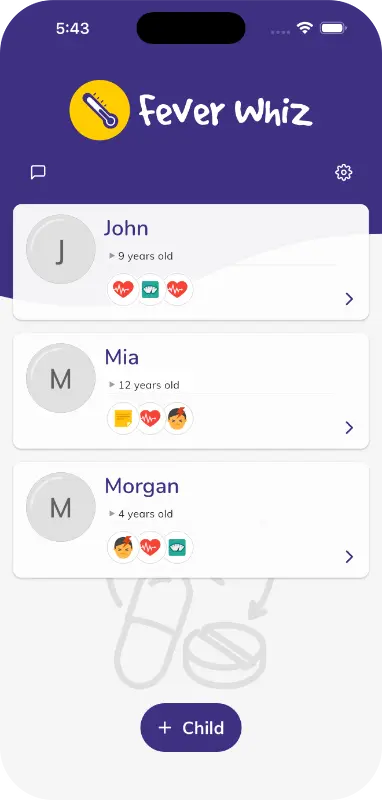
To help you keep track of temperatures, symptoms, and medication doses during stressful times, consider using the Fever Whiz app. It helps parents and caregivers log every dose and temperature, set reminders, visualize trends with charts, and share a real-time care timeline with everyone caring for the child. It is a private record-keeping tool designed to make those tough nights a little easier to manage.