"We need you to pick up. He has a fever of 101."
Before you have even finished reading the text, your brain has already pulled up the calendar. You’re counting backward: when was he exposed? You’re counting forward: if the daycare policy says "fever-free for 24 hours," does that mean he can return Wednesday or Thursday? You’re calculating sick days and emailing your boss before you’ve even found your shoes. It is a frantic, familiar math for any working parent, and often, the numbers don't add up the way we expect them to.
We rely on these rules to give us certainty, but biology is rarely that neat. Understanding why contagious windows differ—and why that daycare exclusion policy sometimes feels at odds with what your pediatrician says—can help bridge the gap between the rulebook and reality.
📏 What the "24-Hour Rule" Is Actually Measuring
Most schools and daycares rely on the "fever-free for 24 hours without fever-reducing medicine" rule as their golden standard for return. While it can feel arbitrary when you are staring at a calendar, this policy is designed with specific public health goals in mind. It serves as a practical, observable proxy for when a child is likely past the peak of infectiousness, even if it isn't a perfect scientific measurement for every single illness.
- Understand that this rule aims to ensure the child’s immune system has gained the upper hand, reducing the "viral load" they shed into the environment.
- Recognize that fever-reducing medicines can mask a fever, making a child appear well when they are still actively fighting an infection and potentially contagious.
- Picture the policy as a safety buffer that accounts for the time it takes for a fever to truly break and stay broken naturally.
- Remember that schools use this rule because it is observable and enforceable, unlike complex lab tests or symptom charts that vary by illness.
🦠 When the "Enemy" Is Already Inside the Gates
One of the most confusing aspects of pediatric illness is that the contagious window often starts before the first sniffle or fever appears. This is why outbreaks spread so quickly in group settings; by the time a child looks sick, they may have already been sharing germs for days. This phenomenon is specific to the biology of different viruses and bacteria.
- Learn that for many common illnesses, the incubation period—the time between catching the germ and showing symptoms—includes a phase of "asymptomatic shedding."
- Know that with viruses like the common cold or RSV (Respiratory Syncytial Virus), a child is often most contagious in the day or two before symptoms become obvious.
- Realize that Hand, Foot, and Mouth Disease is notorious for shedding virus in stool for weeks after symptoms resolve, even if the acute contagious period is earlier.
- Observe that this pre-symptomatic spread is exactly why hand hygiene and general cleanliness are emphasized year-round, rather than just when a classmate is visibly ill.
📊 Why Different Illnesses Play by Different Rules
If you have ever wondered why one illness requires 24 hours at home while another keeps a child out for days, the answer lies in how different pathogens behave. Not all germs follow the same timeline, which can make the "24-hour rule" feel inconsistent. The duration of contagiousness depends heavily on the specific virus or bacteria causing the infection.
- Consider influenza, which typically has a contagious period of about one day before symptoms start and up to five to seven days after.
- Contrast this with whooping cough (pertussis), where a child may be contagious for up to three weeks if untreated, or five days after starting appropriate antibiotics.
- Note that pink eye (conjunctivitis) varies by cause: bacterial cases clear quickly with treatment, while viral cases can be contagious for as long as symptoms last.
- Remember that public health guidelines for specific illnesses (like strep throat, which usually requires 24 hours of antibiotics before return) are based on how quickly the germ stops spreading.
🤝 When the Pediatrician and the Policy Disagree
It is incredibly frustrating to take your child to the pediatrician, hear "they are fine to go back to school," and then have the school nurse send them home—or vice versa. This conflict usually isn't about one party being "wrong." It is about the difference between clinical judgment and policy enforcement.
- View the pediatrician’s role as assessing the individual child: Are they hydrated? Is their breathing clear? Are they well enough to participate in activities?
- See the school or daycare policy as a risk-management tool designed to protect the entire classroom population, including vulnerable children and staff.
- Acknowledge that a doctor might clear a child with a lingering cough because the cough is no longer infectious, but the school policy may exclude any "persistent cough" to be safe.
- Accept that both perspectives can be valid: the doctor is looking at the child's health, while the school is looking at the community's exposure risk.
🌡️ How the Body Sets Its Thermostat
To understand why we use fever as a benchmark, it helps to understand what a fever actually is. It is not just a symptom; it is a biological strategy. The body raises its internal temperature to create an environment where viruses and bacteria struggle to thrive, essentially "cooking" the invader to help the immune system win.
- Imagine the hypothalamus in the brain acting like a thermostat, resetting the body's set-point higher when it detects an infection.
- Visualize the fever breaking as the hypothalamus turning the thermostat back down, causing the body to sweat and cool off naturally.
- Understand that when a fever is suppressed by medication, the "thermostat" setting drops artificially, giving a false signal that the battle is won.
- Recognize that a natural, sustained return to normal temperature is the body's best signal that the active fight is winding down.
⚠️ When to Call the Pediatrician
While this post explains the general rules of contagion, every child and every illness is unique. There are times when the "wait and see" approach isn't enough, and professional guidance is needed. Pediatric and public health sources widely list specific warning signs that warrant a conversation with a healthcare provider.
- Look for signs of dehydration, such as a dry mouth, lack of tears when crying, or significantly fewer wet diapers than usual.
- Note if a fever lasts more than a few days (generally defined as three days or 72 hours for children over three months) or rises extremely high.
- Observe if the child has difficulty breathing, is breathing rapidly, or seems to be working hard to get air in.
- Watch for a rash that appears alongside a fever, or any sudden change in the child's alertness or responsiveness.
Quick Action Plan
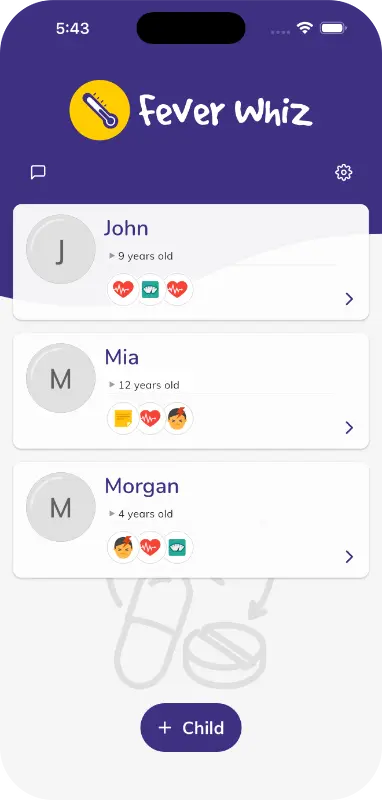
- Download the "Fever Whiz" app to log temperatures, symptoms, and medication doses in real time.
- Use the app's charts to visualize the fever trend, helping you see if it is breaking naturally or persisting.
- Share the app’s timeline with your partner or caregivers so everyone knows exactly when the last dose was given.
- Keep a printed copy of your school or daycare’s exclusion policy on the fridge for quick reference during a sick morning.
- Contact your pediatrician if you see any warning signs or if the illness trajectory doesn't match the expected course.
Disclaimer: This article is for educational purposes only and does not constitute medical advice. Always consult your pediatrician or a qualified healthcare professional for any questions regarding your child’s health, symptoms, or treatment.
About Fever Whiz: Fever Whiz is a free child medication, fever, and symptom tracker for parents and caregivers. Log every dose, temperature, and symptom; set custom and smart reminders; visualize trends with charts; store important medical documents; keep care notes and a care team; and sync in real time across everyone caring for your child. It is a private record-keeping and organization tool—not a medical device—and does not provide medical advice or diagnosis.